

“If ever the Time should come, when vain & aspiring Men shall possess the highest Seats in Government, our Country will stand in Need of its experienced Patriots to prevent its Ruin.”
Samuel Adams
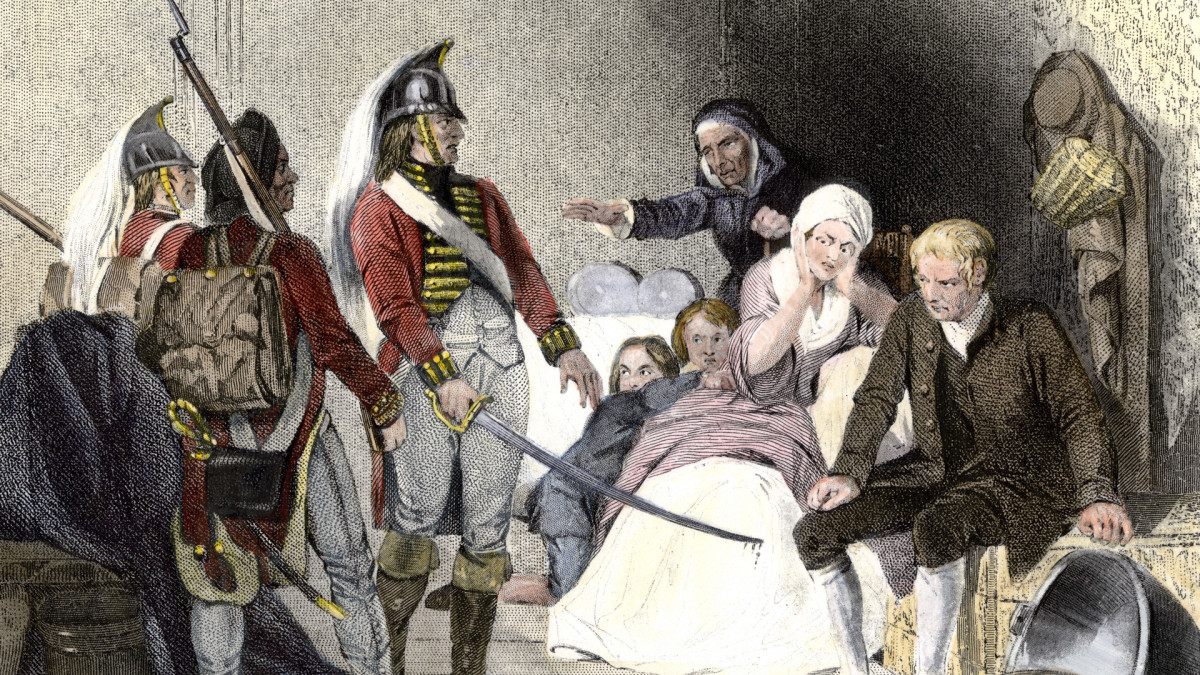
The British troops were a regular fixture in the American Colonies leading up to the Revolution. During the period known as the French and Indian Wars, the colonies were asked to support the troops with supplies and housing when needed. Most colonists did not complain about the burden during the fighting, however, after the war ended, the troops remained in the colonies.
Keeping up troops during a time of peace became more of a bone of contention as time went on. In 1765 Parliament passed a Quartering Act requiring the Colonies to provide barracks and supplies for the troops kept in their midst. In 1774, Parliament passed a Quartering Act giving British authorities the right to secure housing and supplies for the troops without waiting for barracks. This allowed troops to be moved into a city quickly and made it more difficult for local authorities to keep troops to the outskirts of town.
Colonists felt first-hand the oppression of having troops kept up for enforcing government dictates on the people. There were even instances of violence brought on by these heavy-handed measures; the most famous of which was called the Boston Massacre where five were killed and three were injured.
The speech by Dr. Benjamin Rush on the fifth anniversary of the Boston Massacre gives us the feelings of the colonists during this time:
“but you will permit me to say that with a sincerity equal to theirs I mourn over my bleeding country: with them I weep at her distress, and with them deeply resent the many wrongs which she has suffered from the hands of cruel and ungodly men.
That personal freedom is the natural right of every man; and that property, or an exclusive right to dispose of what he has honestly acquired by his own labor, necessarily results therefrom, are truths which none but knaves and fools will venture to deny.”
Provocation by Great Britain:
Parliament. The Quartering Act of June 2, 1774
An act for the better providing suitable quarters for officers and soldiers in his Majesty’s service in North America.
WHEREAS doubts have been entertained, whether troops can be quartered otherwise than in barracks, in case barracks have been provided sufficient for the quartering of all officers and soldiers within any town, township, city, district, or place, within his Majesty’s dominions in North America: And whereas it may frequently happen, from the situation of such barracks, that, if troops should be quartered therein, they would not be stationed where their presence may be necessary and required: be it therefore enacted by the King’s most excellent majesty, by and with the advice and consent of the lords spiritual and temporal, and commons, in this present parliament assembled, and by the authority of the same, That, in such cases, it shall and may be lawful for the persons who now are, or may be hereafter, authorised be law, in any of the provinces within his Majesty’s dominions in North America, and they are hereby respectively authorised, impowered, and directed, on the requisition of the officer who, for the time being, has the command of his Majesty’s forces in North America, to cause any officers or soldiers in his Majesty’s service to be quartered and billetted in such manner as is now directed by law, where no barracks are provided by the colonies.
II. And be it further enacted by the authority aforesaid, That if it shall happen at any time that any officers or soldiers in his Majesty’s service shall remain within any of the said colonies without quarters, for the space of twenty-four hours after such quarters shall have been demanded, it shall and may be lawful for the governor of the province to order and direct such and so many uninhabited houses, out-houses, barns, or other buildings, as he shall think necessary to be taken, (making a reasonable allowance for the same), and make fit for the reception of such officers and soldiers, and to put and quarter such officers and soldiers therein, for such time as he shall think proper.
III. And be it further enacted by the authority aforesaid, That this act, and every thing herein contained, shall continue and be in force, in all his Majesty’s dominions in North America, until the twenty-fourth day of March, one thousand seven hundred and seventy-six.
Colonial Response:
The Declaration of Independence
Among the list of Offenses committed by the King –
“For Quartering large bodies of armed troops among us:”
The Founders Solution:
U.S. Constitution, Amendment III
“No Soldier shall, in time of peace be quartered in any house, without the consent of the Owner, nor in time of war, but in a manner to be prescribed by law.”
“The truth is, all might be free if they valued freedom, and defended it as they ought.”
Samuel Adams
Leave a Reply
You must be logged in to post a comment.